The Linear SDLC Is Dead — Long Live Continuous Software Delivery

For decades, software engineering was taught as a neat, orderly sequence:
requirements → design → code → test → review → deploy → monitor
It looks clean on a slide deck. It feels controllable in project plans.
But in real production environments, this model quietly collapses.
What has actually “died” is not the Software Development Life Cycle itself, but the belief that software can be built in a predictable, linear, one-pass flow. Modern systems, teams, and user expectations have outgrown that illusion.
This article explains why the linear SDLC no longer reflects reality, what has replaced it, and what practical changes engineering teams must embrace to stay effective.
The SDLC Was Never Wrong — The Assumption Was
The individual phases of SDLC are still real:
- Requirements
- Design
- Implementation
- Testing
- Review
- Deployment
- Monitoring
What is obsolete is the assumption that:
You can finish one phase completely, then move cleanly to the next, and never come back.
In practice:
- Requirements change after deployment
- Design evolves during implementation
- Testing influences architecture
- Monitoring redefines product direction
- Incidents rewrite priorities overnight
The old model assumes certainty up front.
Modern software operates under uncertainty by default.
Why the Linear Model Collapses in Real Systems
The linear SDLC breaks down because software today is:
1. Built in Uncertainty
Users do not behave as specified.
Stakeholders change direction.
Markets shift.
Competitors launch unexpected features.
Any process that assumes stable requirements is fragile.
2. Running in Production While Still Being Designed
Modern systems are:
- Continuously deployed
- A/B tested
- Feature-flagged
- Canary released
- Gradually rolled out
This means design decisions continue after deployment.
Production is no longer the “end of development” — it is part of development.
3. Dependent on Feedback Loops
In modern teams:
- Monitoring informs requirements
- Incidents change design
- User behavior changes roadmap
- Performance bottlenecks reshape architecture
If your process does not treat feedback as a first-class input, it is disconnected from reality.
What Replaced Linear SDLC: A Continuous Feedback System
Modern software delivery looks less like a straight line and more like a learning loop:
observe → learn → decide → build → test → ship → observe again
Key differences:
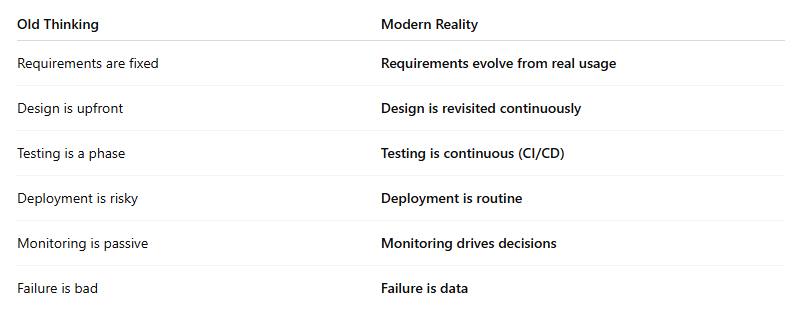
The system is no longer optimized for predictability.
It is optimized for learning speed.
Rework Is Not Failure — It Is the Core Mechanism
In the linear model, rework is treated as waste.
In modern engineering, rework is evidence of learning.
Rework happens because:
- Users behave differently than expected
- Load patterns break assumptions
- Edge cases emerge in production
- Business priorities shift
- Technical constraints surface late
The goal is not to eliminate rework.
The goal is to make rework cheap by:
- Shipping in small increments
- Avoiding premature over-design
- Using feature flags
- Maintaining strong automated test coverage
- Designing for changeability
Small rework early is healthy.
Large rework late is organizational debt.
Why People Say “SDLC Is Dead”
What they are really rejecting is:
- Phase-gated delivery
- Big upfront design
- Locked requirements
- Late testing
- Heroic deployments
- Post-mortems that never change behavior
These patterns fail in environments with:
- Continuous deployment
- Cloud infrastructure
- Distributed systems
- Rapid market change
- High user expectations
So when people say “SDLC is dead,” they mean:
The predictive, document-driven SDLC is no longer economically viable.
The Modern SDLC Is a Living System, Not a Pipeline
A more realistic mental model is:
- Monitoring feeds requirements
- Incidents reshape architecture
- Design changes during coding
- Testing influences system boundaries
- Deployment is a daily activity
- Post-release learning shapes the next iteration
This is not a loop.
It is a network of continuous feedback.
The system never “finishes.”
It stabilizes temporarily, then adapts again.
Other Critical Points Teams Often Miss
1. Documentation Is a Byproduct, Not the Source of Truth
In modern teams:
- The code
- The tests
- The observability
- The runbooks
- The incident reports
…become more truthful than outdated design documents.
Documents should support decision-making, not pretend to predict reality.
2. Deployment Is a Skill, Not an Event
Frequent deployment is not about speed alone.
It is about risk management.
Small, routine deployments are:
- Easier to debug
- Easier to rollback
- Easier to reason about
- Safer for customers
Rare deployments are dangerous deployments.
3. Monitoring Is a Product Feature
Monitoring is not only for ops.
Good monitoring:
- Shapes product decisions
- Exposes UX friction
- Reveals hidden workflows
- Identifies waste in user journeys
If monitoring is not discussed in product reviews, your roadmap is partially blind.
4. Architecture Must Optimize for Change
Modern architecture must value:
- Replaceability over perfection
- Observability over elegance
- Loose coupling over clever abstractions
- Operational clarity over theoretical purity
A beautiful architecture that resists change is organizational friction.
5. Process Design Is a Business Decision
The way you design your SDLC determines:
- How fast you can respond to market change
- How expensive your mistakes are
- How often you learn from production
- How safe your deployments feel
- How much stress your engineers carry
This is not an engineering detail.
It is strategic leverage.
A More Accurate Statement Than “SDLC Is Dead”
A better framing is:
The linear, predictive SDLC is obsolete.
The lifecycle itself still exists, but it is now continuous, adaptive, and feedback-driven.
Or more bluntly:
Software is no longer delivered.
It is continuously learned into existence.
Practical Implications for Teams
If your team still operates like:
- “Requirements are finished”
- “Design is locked”
- “Testing comes later”
- “Deployment is scary”
- “Monitoring is for ops”
You will experience:
- Late-stage rework
- Slow delivery
- Fragile releases
- Product misalignment
- Operational burnout
Modern teams instead optimize for:
- Fast learning
- Small batch changes
- Continuous validation
- Operational feedback
- Design for reversibility
Finally
The biggest mistake teams make today is not using old SDLC terminology.
It is believing the old mental model still fits modern software reality.
The future of software engineering is not about better planning.
It is about building systems and teams that learn faster than reality changes.


Comments ()